PandaBaby is True Fiction.

Welcome to my Pandababy Blog. A panda bear is an unlikely animal - a bear that eats bamboo - a contradiction in every aspect. This blog is true fiction, also a contradiction in its essence. Yet both are real, both exist - the bear and the blog. Both can only be described by contradictory terms, such as true fiction. Please be pleased to enjoy these stories of our ancestors. They are True Fiction. Every person in my blog lived in the time and place indicated. They are my ancestors and relatives, and their friends.

Wednesday, December 28, 2022

James Sherrill: Toll Bridges and Indians

 The second day out from crossing the Missouri, Mary Ann and James saw a bridge over a creek. The sign said "Big Papillion Creek". The Indian standing with his arms crossed over his chest in the middle of the bridge entry said nothing until they came close. Then he told them they must pay fifty cents to cross the bridge. James dug in his pocket and brought out his coins, kept in a small rawhide pouch.

"Well I hope there are not too many toll bridges ahead!" cried Mary Ann.

"Not many toll bridges," replied James. "The Barlow road, which is our cut-off to the Willamette Valley, is where we'll have to pay a few hefty tolls. Those toll gates are not run by Indians, but by white men."

"Why do they think they can charge all of us a toll?" asked Mary Ann.

"I suppose because they did the road work, removing boulders and trees, making the roadway safer. Your father went over the problems we'll face on this trip with me before we left. He's a wise man, your father, to have gone to Oregon and back the year before our trip, and discovering what we need to do to get ready. He told me there are several toll gates coming down from Mt Hood, and all of them are costly."

"Would it be just as costly to go down the Columbia River to Portland, then turn south to our land claim?"

"More costly than the Barlow Road, Mary Ann, and also more dangerous. Richard looked into both routes on his trip in '51. Many of the published guides to Oregon are written by people who expect to profit from new settlers. They exaggerate the benefits and skip over the perils. That is why Richard felt it was important to see for himself, before risking his family on this adventure. He wanted to see the land, and know if it was worth the effort to get there."

"If we just get to our land in Oregon safely I shall be very grateful," she replied. 

James reassured her, "Richard added up the cost of toll bridges, ferries, and the Barlow Road toll gates, so we know what it will cost us, and we all have money set aside. We can't avoid the dangers, like the risk of swimming the cattle across the rivers, but thanks to your father, we are prepared for what is ahead."

Tuesday, December 27, 2022

James Sherrill: Summer heat turned muddy roads into fine dust

which choked the travelers and clogged the nostrils of the oxen. James soaked a rag in clean water, and wiped the nostrils of all eight of his oxen, carefully removing the caked dust. It was enough to literally kill one the valuable animals if they were not helped by their drovers. They saw terrible evidence of that along the side of the road as they traveled.

Wolves and Buffalo documentary by Jeff Turner on PBS

Every night, James set up the tent they slept in, which during the day was carried under the wagon. Although the tent was more comfortable than the wagon for sleeping, it felt suffocating on these hot nights. Between the heat, and the occasional gunshot from nervous night guards, plus the howling of wolves, it was a wonder any of them got enough sleep to be able to work. Mary Ann walked along the next day, putting twigs and buffalo chips into the bag for building the fire that night. She considered as she walked, how little she had appreciated a bed that didn't move, a room with walls, a house that exuded quiet and peace, when she had them each and every day and night.

Sunday, December 25, 2022

For Mika - cover of book for you


Mika Bui

Oregon Trail Ancestors – 1852

"Courtesy of the University of Texas Libraries, The University of Texas at Austin." Feydey
From The Ox Team or the Old Oregon Trail 1852-1906 by Ezra Meeker. Fourth Edition 1907
CLICK ONCE TO SEE LARGE IMAGE, ONCE MORE TO RETURN (Image of map in Public Domain)

        Four Oregon Trail Pioneer Ancestors from 1852
of
Mika Bui


Mika's great-great-great-grandparents:
James Sherrill & Mary Ann Evans, m 13 May 1852
Wapello County, Iowa to Linn County, Oregon in 1852

Mika's great-great-great-great-grandparents:
Richard Evans & Nancy Toone, m 30 Aug 1818
Wapello County, Iowa to Linn County, Oregon in 1852


Research and Writing by April (Dellinger) Dauenhauer

2022
                                                                        

James Sherrill - Across the Missouri - May 1852

 "It required a great deal of manual labor to propel one of the ferry boats.The one that ferried thousands of emigrants across the river at Kanesville was a scow which was pulled [along] a rope made fast on each side of the river." "Where the water was shallow, they used spike poles, and where it was deep they used oars. Two wagons were all that could be ferried at one time....hundreds of wagons waiting and hundreds coming every day." (Mary Ann Boatman on her crossing the Missouri in 1852, in "Surviving the Oregon Trail 1852", Weldon Willis Rau, copyright 2001.)

Even with three ferries running wagons across the Missouri at Kanesville (later known as Council Bluffs), it took all day for their wagon train of 200 wagons - plus all the livestock - to cross to the west bank of the Missouri River. Although it was dangerous, men would swim their herds of cattle across the river, both to save time and money. There was no  question about the smaller animals -- pigs, sheep, goats, etc. had to be loaded onto the ferries.

Mary Ann and James, and the whole family group, spent Friday, Saturday and Monday in final preparations before they could cross the Missouri River. A month's worth of their stores, used up in crossing Iowa, was replenished at the general stores that stocked everything the emigrants could want. Sunday as usual was given to rest and worship. They were all up before the dawn on Tuesday, April 18th, lining their wagons up on the bank of the Missouri for their perilous trip over in the scow. Suddenly the air was rent by the shrill whistle of a steamboat -- the El Paso had arrived.

The steamboat had come up the Missouri and was offering tickets across for $10 per wagon, four yoke of cattle included. How paltry their $4 tickets to cross on the old scows looked now, and they would have to swim their cattle across, at great risk. The rush for steamer tickets was great, but they were already in the line for their scheduled scow. The next day, May 19th, they were in camp down the road when they heard another steam boat whistle, announcing the arrival of the Robert Campbell.

Either one of the steam boats could carry over a dozen wagons with their cattle per trip, and make over a dozen trips per day, and another dozen trips at night. Emigrants coming up on them from behind were quick to inform them of the situation back in Kanesville. Within two days a thousand wagons, with their people and stock, were overtaking the Evans wagon train on the road just west of the Missouri River. According to one traveler on the west bank, "we were overtaken by this throng of a thousand wagons thrown upon the road, that gave us some trouble and much discomfort". (Mary Ann Boatman, in "Surviving the Oregon Trail 1852" by Weldon Willis Rau, Washington State University Press, 2001.)

The Evans' train started in the dark, early the next day, trying to outdistance the rolling wave of wagons behind them. By noon they made a small circle of their fourteen wagons, as all the groups in the large train were doing, and built a campfire where they could have hot coffee and dinner going. James and Mary Ann were glad to have beans, bacon, and corn bread with their coffee. Mary Ann worked with her mother Nancy and the other wives in their group, making their meal as quickly as possible. They needed to stay ahead of that humongous wave of people and oxen behind them. Such a large mess of cattle and people - ten times the size of their wagon train, would use up the firewood, muddy the water and finish off the grass. Later on in their journey, the wagon trains would achieve a regular distance between each other, but for now it was best for them to make haste.

"Courtesy of the University of Texas Libraries, The University of Texas at Austin." Feydey
From The Ox Team or the Old Oregon Trail 1852-1906 by Ezra Meeker. Fourth Edition 1907

The emigrants charted their trip by The Platte River. Some traveled west on the north side of the Platte, some on the south side. Some crossed from one side to the other during the journey. The goal was to find plentiful wood for their cook fires, grass for their oxen and other livestock, and clean drinking water for humans and animals. Because the Platte River featured in their travels for a large part of the Oregon Trail, witty sayings arose to describe it. "A mile wide and an inch deep" went one aphorism. Another common description of the Platte River was “too thick to drink, but too thin to plow.” The Great Plains Trail describes the Platte in more detail.

As they journeyed west next to the Platte, James and Mary Ann shared in the common worries of the wagon train company. Would hostile Indians appear and attack? But time revealed that all Indians wanted was to get food or tobacco (although they were not above stealing an unguarded horse or ox).

The real terror of the Oregon Trail revealed itself only gradually, in the increasing number of graves they saw by the side of the trail. They soon learned the name of the dread killer of so many emigrants: cholera! It attacked men, women and children equally. One could be healthy in the morning and dead by noon. There were many ways to die on the road to Oregon: drowning, rattlesnake bite, a stampede, pneumonia from exposure to cold and storms, gunshot accidents, and more. But by far the greatest killer was cholera, which carried off over one out every ten emigrants on the Oregon Trail.

Mary Ann expressed her feelings to James one evening: "If I had realized what dangers would accompany us on this trip, I would never have wanted to come. But I'm glad I didn't know, because I wouldn't want to miss it, either." So the adventurers journeyed on, brave sometimes in spite of themselves, and Oregon Territory grew ever closer.

Friday, December 23, 2022

James Sherrill - Wagon Train Wedding - Pottawatomie County, May 1852

They had planned for this moment for over a year, but now that it had arrived, Mary Ann was shaking like the proverbial leaf. She looked up at T. Burdick, Judge for Pottawatomie County, and nodded as her brother Edward raised his right hand and swore that "everything was legal and right". James took her right hand in his hand, gave a squeeze to encourage her, and spoke the solemn response "I do". Mary Ann repeated the words, "I do", and the judge, having determined they were of legal age or had parental permission, quickly dispensed with the brief civil words that bound James and Mary Ann together as man and wife for the rest of their natural lives. Edward stepped up to kiss the bride. Judge Burdick shook hands with James.

They left the courtroom quickly, giving place to other engaged couples who would be married before starting out on the Oregon Trail. A single man in Oregon could claim 160 acres of land from the government, free if they "improved the land". A married couple could claim 320 acres of land from the government. Judge Burdick was doing a brisk business that 13th day of May, 1852, as wagon train companies prepared to cross the Missouri River and go over 2,000 miles west on the Oregon Trail.

Mary Ann Evan's father and mother, Richard and Nancy Evans, were among the witnesses to her marriage. Her little niece tossed flowers in her path as she walked back to their wagon. The entire company of travelers cheered and applauded James and Mary Ann as they approached the camp. Fiddles and banjos were going, anyone who was not minding children or cooking the meal was dancing, and it was, as Mary Ann declared to James later that evening, "the perfect wedding".

Her mother had already helped Mary Ann move her belongings into James' wagon. Her quilting circle had made her a gift -- a signature quilt. Each quilt block contained the signature of one of the quilting group members, or one of Mary Ann's family who was staying behind. Now it was spread out over new sheets that Mary Ann and Nancy wove. Wearing her white cotton nightgown, embroidered with flowers and bluebirds by Mary Ann herself, with her long wavy hair down over her shoulders to her waist, Mary Ann was a picture perfect bride.

She asked James if they could start their married life by praying together before bedtime. Her father had already told him that would be expected of him, so he smiled and nodded. They would begin their marriage by acknowledging God in all their ways, and asking His blessing on their lives. Their ferry ticket to cross the Missouri was for early morning on May 18th. They were young and strong and filled with joy. Their Oregon Trail honeymoon began tonight.

Surely with all their work and preparation, it would be a wonderful journey. They would reach Oregon Territory by September, and claim their 320 acres.They had left behind the rising controversies over slave states and free states. The newly published and immensely popular book, Uncle Tom's Cabin, couldn't affect them. Oregon was beyond that. They would have it all - a new life, a new family, a new farm and a new home.

Emigrants near Missouri River in 1852 at the Kanesville crossing
near Council Bluffs, Iowa
. Jackson, William Henry, 1843-1942,
Courtesy, L. Tom Perry Special Collections, Harold B. Lee Library,
Brigham Young University, Provo, UT 84602.

Tomorrow: Crossing the Missouri River

James Sherrill - Wagon Train - Ready, Set, Go!

Wapello County, Iowa - Summer, 1850

"Margaret, who is that tall girl over there with the dark hair?" 

"What girl, James? Oh! You must mean Mary Ann Evans. She is in my quilting circle - would you like me to introduce you?"

And that is how it began, that James Sherrill and Mary Evans got engaged to be married. They were both children of pioneer farmers, who had grown up on the frontier. They started talking with each other at that first meeting after church one Sunday, and afterwards were usually found together, in church, at socials, riding in his borrowed buggy -- it was clear they were headed for the altar. 

Wapello County, Iowa - Autumn, 1851

Richard Evans considered the young man's request, that he be included in the Evans' wagon train when they left Wapello County in the spring next year. James Sherrill continued, "Yes sir, I'll be twenty-two this autumn, and I will have my own wagon and supplies. Yes, I've raised and trained my own oxen. My best team has been together for four years, and my new team has been in training two years. I'll have a team and spare team, and we won't make delays for you."

"You can come with our group if I'm satisfied that you have the necessary gear and supplies ready when I look at it come March. I'll give you a written list - we can discuss the details later. We have about eight wagons that are family, and we'll have to join up with a larger wagon train when we reach Kanesville on the Missouri River. Come to dinner after church Sunday and we'll talk some more," advised Richard, as he climbed into his farm wagon.

No one with any sense set out on the Oregon Trail without getting everything ready. Get the rifles ready - check. Get the lead for bullets ready - check. Get the iron for shoeing the oxen and horses ready - check, check, check, all the way down a very long list of clothes, food, tools, and stuff that would go in the wagon. Wagon - check. Reinforced, covered with hoops, covered with cloth and then covered with water-proof cloth, Loaded with water barrel, hung with lanterns, anything forgotten they would have to do without -- no supply stores for two thousand miles! It was all anyone thought about or talked about for the entire year before they left. No such thing as being over-prepared.

The next  spring, 10 April 1852...

This file is licensed under the Creative Commons Attribution-Share Alike 4.0
International, 3.0 Unported, 2.5 Generic, 2.0 Generic and 1.0 Generic license. by Cgoodwin

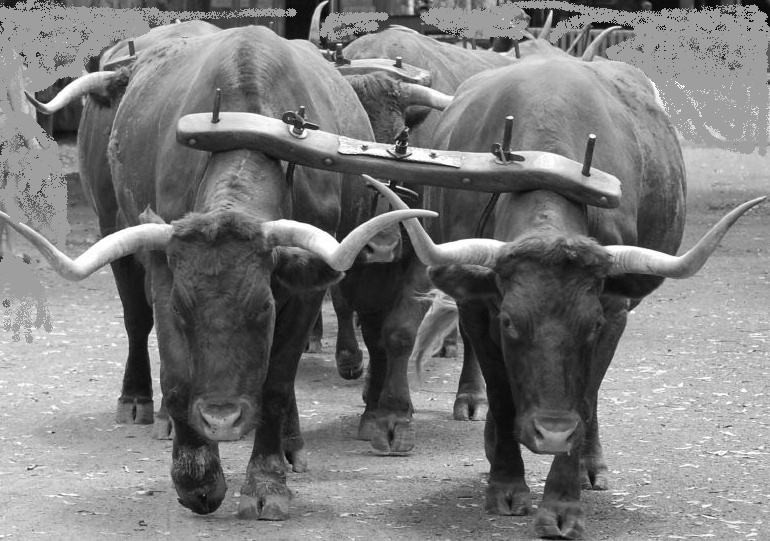
Mary Ann leaned forward on the wagon seat, as if to see around the bend in the road. Next they would pass Philomon Johnson's farm, where Margaret Sherrill-that-was Johnson would be waving goodby to her brother James Sherrill - IF he was ready and waiting to join the wagon train as they passed. Oh! Yes! He had hitched all of his eight oxen up to his wagon, instead of tying the four on the second team behind it. Oh how magnificent it looked, and how the great beasts carried their heads, so proudly, as if they knew they made a great sight.

James threw her a smile, and touched the brim of hat as he walked by the head of his lead ox, guiding them into the roadway behind her brother Edward's wagon. They all had agreed on their assigned places as they left town, and each night at camp they would agree on their rotating assignments, so that no one wagon would have to 'eat dust' all the way to Oregon -- they would take turns at taking up the rear of the wagon train.

Mary Ann would have to walk most of the way, as would her fifty-four year old mother, her six year old cousin Mary Kyniston, and in fact, about everyone unless they were infants or sick. For just this day, the women and children would ride, while the men guided the oxen, walking by them as usual. The brightly painted wagons made them look like a circus as they passed down the road. At every farm, the dogs came out to bark at them, and the farmers and farm wives paused from their labor to shout 'good journey' to them.

They wouldn't always have a blue sky, but it was encouraging weather to begin their journey. It would take a month just to get across Iowa to Kanesville, and until they left Kanesville and crossed the Missouri River, they could not even say they had started on the Oregon Trail. Iowa was a state of the United States, since 1846. Across the river -- wilderness, the Great Plains, known for one thing -- emptiness. Once across the river they were leaving civilization for the six months it would take them to get to Oregon Territory.

Tomorrow: a wagon train wedding, section two of Oregon Trail Honeymoon